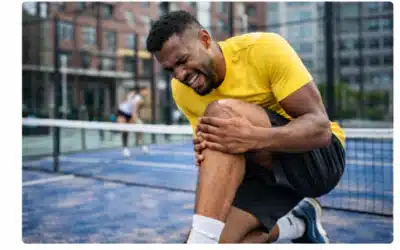
An anterior cruciate ligament (ACL) injury is one of the most significant injuries in sport. It affects not only the knee, but a person's confidence, identity, and long-term joint health. This guide walks through what the ACL does, what happens when it tears, how the surgery-versus-conservative decision is made, and what a structured rehabilitation programme looks like from day one through to a confident return to sport.
What is the ACL and what does it do?
The anterior cruciate ligament is one of four main ligaments that stabilise the knee. It runs diagonally inside the joint and has two jobs: it stops the shin bone (tibia) sliding forward on the thigh bone (femur), and it resists twisting, rotational forces. Those are exactly the forces involved in cutting, pivoting, and decelerating, which is why the ACL matters so much for sport.
One important point is that the ACL has a poor blood supply. Unlike many soft tissues, a fully torn ACL does not reliably heal back together on its own. This is a big part of why the treatment decision is more involved than it is for something like a muscle strain.
How ACL injuries happen
Around 70% of ACL tears are non-contact injuries. They happen during a sudden deceleration, a landing from a jump, or a change of direction with the foot planted. The classic mechanism is a twisting force on a slightly bent knee, often with a loud pop, rapid swelling within a few hours, and a feeling that the knee has given way.
Some factors raise the risk. Fatigue late in a game changes how people land and cut. Landing with a relatively straight knee, or with the knee collapsing inward, loads the ligament more. Female athletes have a higher rate of ACL injury than male athletes in the same sports, which is thought to relate to a mix of biomechanical, hormonal, and neuromuscular factors. The encouraging part is that several of these risk factors respond well to targeted strength and landing training, which is why prevention programmes work.
What to do immediately after an ACL injury
In the first few days after a significant knee injury, the priorities are simple: settle the swelling, protect the joint, and keep it moving gently within comfort. The current first-aid approach is summarised as PEACE and LOVE: Protect, Elevate, Avoid overusing anti-inflammatories, Compress, and Educate early on, then Load, Optimism, Vascularisation, and Exercise as things settle. In plain terms, rest the knee from aggravating activity at first, use ice and elevation for comfort, and gradually reintroduce gentle movement rather than wrapping it up and doing nothing.
Get the knee assessed if you heard a pop, it swelled quickly, it feels unstable, or you cannot put weight through it. Early assessment confirms the diagnosis and rules out injuries that need urgent attention.
Diagnosis
Diagnosis is made through a combination of your history, hands-on special tests (such as the Lachman, anterior drawer, and pivot shift tests), and imaging. An MRI is the gold-standard scan. As well as confirming the ACL tear, it shows whether the meniscus, cartilage, or other ligaments have been injured at the same time, which matters for planning treatment.
Associated injuries: the unhappy triad
The ACL often does not tear alone. A well-known combination, sometimes called the unhappy triad, involves the ACL, the medial collateral ligament (MCL), and the medial meniscus together. Meniscus tears in particular are common alongside an ACL injury and can influence both the surgical decision and the rehabilitation timeline.
This is why a thorough assessment matters. Treating the ACL in isolation while missing a significant meniscus tear leads to a slower, more frustrating recovery. Knowing the full picture from the start means the plan is realistic.
Surgery or conservative management?
Not every ACL tear needs surgery. The decision depends on:
- Your desired activity level, especially whether you want to return to cutting and pivoting sports.
- How stable the knee is with structured rehabilitation. Some people, known as copers, regain good functional stability without surgery.
- Associated injuries such as meniscal tears or cartilage damage.
- Your age, occupation, and personal goals.
For competitive athletes returning to multidirectional sport, surgical reconstruction is usually recommended. For older or recreational people staying within straight-line activity such as running or cycling, structured rehabilitation alone can be very successful. This is a shared decision between you, your physiotherapist, and an orthopaedic surgeon, not a one-size-fits-all rule.
Graft choices if you have surgery
ACL reconstruction does not repair the torn ligament. It replaces it with a graft, usually tissue taken from elsewhere in your own body. The three most common choices are the hamstring tendon, the patellar tendon, and the quadriceps tendon. Each has trade-offs in strength, recovery, and the small risks specific to where the tissue is taken from.
The right choice depends on your sport, your surgeon's experience and preference, and your own circumstances. It is a decision made with your surgeon, but it is worth understanding going in, because the graft type can slightly influence how the early rehabilitation is structured.
Prehabilitation: why what you do before surgery matters
If you are having reconstruction, the weeks before surgery are not dead time. The strength, range of movement, and swelling level of your knee going into the operation are among the best predictors of how well you do afterwards. A knee that is strong, settled, and moving well before surgery recovers more smoothly than a knee that is swollen, stiff, and weak.
This pre-surgery work is called prehabilitation. The goals are to reduce swelling, regain full extension, and rebuild as much quadriceps strength as possible before the operation. It is one of the most worthwhile things you can do while waiting for surgery.
The four phases of ACL rehabilitation
Phase 1: early recovery (0 to 6 weeks)
The priorities are restoring full passive knee extension, reducing swelling, regaining quadriceps activation, and walking normally without crutches. Getting the knee fully straight early is important and sometimes neglected, yet it strongly affects the final outcome. Early progressive loading, guided by your physiotherapist, is now well supported by the evidence and has replaced the older approach of prolonged rest.
Phase 2: strength and neuromuscular control (6 weeks to 3 months)
Once range of movement and basic muscle activation return, the focus shifts to building strength symmetry between the two legs, restoring single-leg control, and reintroducing landing mechanics. Access to proper gym equipment such as the leg press, hamstring curls, and split squats matters here, because the strength gap after ACL surgery is significant and resistance bands alone will not close it.
Phase 3: running and plyometrics (3 to 6 months)
A graded return to running usually begins around three to four months, depending on objective strength and movement quality rather than the calendar. Linear plyometrics (straight-line jumping and hopping) are introduced first, progressing from two-legged to single-leg work, with side-to-side and rotational movement added towards the end of this phase.
Phase 4: return to sport (6 to 12 months)
The final phase reintroduces sport-specific cutting, pivoting, deceleration, and contact. Return-to-play decisions should be based on objective testing, including strength symmetry, a battery of hop tests, and movement quality under fatigue, not on time alone. Most people return to sport between nine and twelve months.
The mental side of ACL recovery
An ACL injury is not just a physical setback. The fear of re-injury is real, well documented, and one of the biggest barriers to returning to sport. Many people regain full strength and movement but still hesitate, hold back, or avoid the situations that caused the original injury.
This matters because confidence is part of physical recovery, not separate from it. An athlete who does not trust their knee moves differently, and that altered movement can itself raise re-injury risk. Good rehabilitation addresses the psychological side directly: building confidence through graded exposure, demonstrating progress with objective test results, and being honest about the timeline so expectations are realistic. A questionnaire called the ACL-RSI can track psychological readiness to return alongside the physical measures.
Why criteria-based rehabilitation matters
Returning to sport too early is the single biggest predictor of ACL re-injury. The evidence is clear: each month that return to sport is delayed, up to around nine months, substantially lowers the re-injury rate. Patience and objective testing are not optional extras. They are the foundation of a safe return, and the reason a good programme tests rather than guesses.
Common myths about ACL recovery
- “If the swelling has gone and it feels fine, it has healed.” Feeling fine is not the same as being ready. Strength and control deficits persist long after pain and swelling settle.
- “A torn ACL always needs surgery.” Not true for everyone. Some people manage very well with rehabilitation alone, depending on their goals.
- “I will be back in a few months.” A genuine return to cutting and pivoting sport is usually nine to twelve months, and rushing it backfires.
- “Once I am back, the risk is over.” The first year back is when re-injury risk is highest, so ongoing strength and movement work still matters.
How Full Motion Physio supports ACL recovery
Khuram has guided patients through every stage of ACL rehabilitation, from immediate post-surgical care to elite-level return to sport. The clinic offers direct access to elite-level gym equipment on site, so progressive strength and conditioning can be delivered and supervised in person rather than prescribed and left to chance. The final stage is supported by structured return-to-sport testing, so the decision to go back is based on data, not guesswork.